Search This Blog

Tuesday, March 16, 2021

You've come a long way, baby, but you haven't yet arrived

The current state of marketing to women has a vibe that harkens back to the print ads for Virginia Slims cigarettes that ran through the 1970s and 80s with the tagline, “You’ve come a long way, baby.” The backgrounds were a representation of the bad old days of restrictions on women that contrasted with the confidently posed model holding her slim cigarette.


The bad old days for marketing featured blatantly sexist ads in which women aspired to nothing more than pleasing their husbands or on catching a husband by being pretty and ladylike. We have moved on, but not altogether.

Marketers have become aware of the need to move with the time and have adapted ad images accordingly. The way women are represented in ads is no longer limited to airbrushed models who exhibit the “right” figure, skin tone, hair, and age.

While ad imagery has come a long way, surveys of women indicate that marketing still has a long way to go.


Only 29% of American women believe advertising portrays them accurately is the title of Callie Schweitzer’s LinkedIn article posted on March 9, 2021. The statistic comes from Morning Consult. Even men weren’t fully convinced, as less than half (44%) said they considered women’s representation accurate.

That's not exactly passing marks.

A flame-broiled fiasco on International Women’s Day 2021

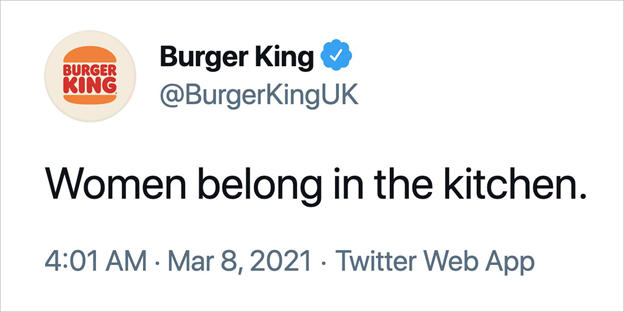
You don’t have to look hard for the brand that seriously misread the room in issuing a Tweet in honor of International Women’s Day, and the Internet made sure you knew about it even after the Tweet was deleted.


The extremely provocative-sounding declaration was meant to reference support for women who become professional chefs and its project called HER (helping equalize restaurants). But without that immediate context provided only within the print ad that you can see below, there was the apparently sexist declaration alone, and that boomeranged against the brand.


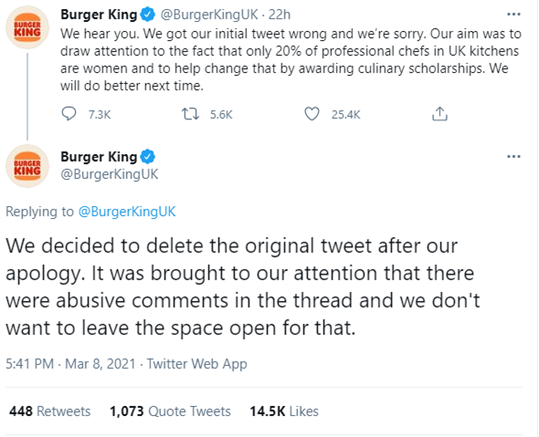
The backlash was so strong, that the account had to offer the combination of an apology and reason for deleting the tweet.


Burger King fell right into that marketing hole that Schweitzer complained about with an assertion that “perpetuates centuries-old cultural stereotypes of what society ‘expects’ women to be.” It should be obvious that marketers should steer clear of marketing to women in such forms. But it is still trickier for them to identify what women do want to see and hear in marketing.

Read more in What Women Want to See in Ads

Thursday, February 25, 2021

Podcasts may be the missing ingredient in your marketing mix

  • Brands that want to strengthen their relationship with their customers are discovering the medium of podcasts. 
  • Podcasts have proven effective for targeting audiences, engaging their attention, and converting customers. 
  • Purchase intent rises significantly for podcast listeners as it captures their attention even when TV, radio, or digital ads fail to. 
Podcasts take off  

The term “podcast” was not something you would have associated with marketing a decade ago. But that has changed drastically as podcasts have been steadily rising in popularity. 

The number of podcast listeners in the United State rose from a mere 32 million in 2013 to a projected 120 million for this year, Statista reported. It derived compound annual growth rate of 17% that anticipates an audience of 164 million for podcasts in 2023.’ 

 Podcast ad revenue has also risen tremendously, more than tripling over the space of just four years. According to Music Oomph!, Podcast ad revenue in 2017 was $317 million, but it is expected to hit $1.13 billion this year and to rise to $1.33 billion next year. 

Become the best CRMer you can: 


Read more in Why It May Be Time to Add Podcasts to Your Marketing Arsenal


Thursday, February 18, 2021

The Big Three in Crypto: Bitcoin, Ripple and Ethereum


https://commons.wikimedia.org/wiki/File:Cryptocurrency_logos.jpg
 

In the beginning, there was Bitcoin, then came Ripple, and then Ethereum. Along the way, many others came and went as cryptocurrency and blockchain protocols moved from the fringe to the mainstream, but these are still arguably the top three.

Cryptocurrency shares the fundamental definition of all forms of money: it is a medium of exchange, a measure of value, and a store of value. What sets it apart from fiat currency, though, is the following:

  1. It has no physical form and exists solely as a digital bit of data.

  2. It is not issued by a government entity.

  3. It is completely decentralized and clears transactions through network consensus rather than through the authorization of a central bank.

  4. Transactions cannot be reversed or charged back as is the case for those cleared by banks.

Beginning with Bitcoin

Though there had been some plans for a system of digital currency set out in the late 20th century, for the early part of the 21st century, the Bitcoin system and its currency unit, bitcoin or BTC was synonymous with cryptocurrency.

In October 2008, the name Satoshi Nakamoto appeared on the paper, Bitcoin: A Peer-to-Peer Electronic Cash System, which explained how the setup of blockchain technology was used in the cryptocurrency.

A blockchain is a decentralized ledger that allows a peer-to-peer network to obtain confirmation of transactions without waiting on a central clearing authority.


Read more in  The Differences Between the Top 3 Cryptocurrencies


Related posts Is Digital Currency Catching On?

Blockchain Can Change the Recruiting Game

Can Blockchain Improve Tech’s Workplace Diversity?
Blockchain & the Gold Standard for a Conflict-Free Supply Chain
Countering Counterfeit Drugs with Blockchain
 Can You Obtain Certifications for a Blockchain Career?

How Crypto Can Help Women Gain More Equal Footing in Business Leadership


Facebook's Change Of Heart On Cryptocurrency Ads
Using Blockchain To Beat The Bots
Blockchain and the Ad Experience

Friday, January 29, 2021

CRO is like basketball

free image from https://www.dreamstime.com/photos-images/basketball-hitting.html
Conversion rate optimization (CRO) is the term for what marketers do to determine which versions of landing pages or sites yield the best conversion rate. The conversion itself depends on the specific goals in place, the call to action (CTA).

The conversion for an e-commerce site is usually completing a purchase. But it can also be just getting that customer to take the first step on the purchase journey. In such cases, the goal may just be having the prospective customer indicate some level of interest and establishing some kind of connection.

That’s why you have to be clear on your metrics for CRO. It can count as a conversion to have the customer sign up for a subscription to a company newsletter, put in a request for a quote, or even just sharing an email address by signing up for an account.

The way CRO works is like finding the techniques a basketball player can use to get more of the balls he throws into the basket. He’s not taking more throws but throwing more effectively to achieve his goal and score points for the team.
 
That doesn’t assure that they will win every game, but it will tilt the odds in their favor.
 

How to calculate CRO

You calculate the conversion rate by dividing the number of conversions generated by the number of visits to that page, whether it’s a home page, landing page, or blog post. That means that if you have 10,000 visits, out o f which you have 150 conversions, you have a1.5% conversion rate. If your optimization results in getting 200 conversions out of the same number of visits, you’ve achieved a 2% conversion rate.

Given that it is a percentage, a high conversion rate is not a function of a larger number of visits but of more of those visits translating into conversions. That’s what it means to optimize the rate, getting more value out of your existing traffic. It’s not about generating new visitors but out of getting more of the ones you draw to convert.


Phases of conversion rate optimization


CRO involves testing various attributes, from colors to picture placement, to button shapes, to the steps involved in checkout. The first phase in the process of CRO is the research and hypothesis phase, in which the particular attributes that are correlated with better conversions are identified. They are then subject to A/B testing to discover if the site with them does indeed perform better with a lower bounce rate than the one without them.

Why conversion rate optimization is important


Before CRO was adopted as a data-driven practice, the only way to discover if something was promoting or hindering conversion was to set up your site that way and wait a while until you had results. You would then have to guess what needed tweaking, and through trial-and-error may have finally arrived at an optimized site. So while you may have arrived at the same point in the end, it would have only been achieved at the cost of lost conversions for all those months of trying to figure out what are the bottlenecks in your conversion funnel. Now A/B testing tools make it possible to discover the most effective way to set up your website by working through different versions to get data on what works more quickly.

Conversion rate optimization best practices


In general, conversion rates improve when visitors have to do less work to find what they want. That means that sites designed according to CRO best practices typically include a clean look like that allows them to easily navigate to where they want to go, obviously placed and colored specific call to action buttons, and no jumping through hoops for the contact information that provides leads and builds connection, whether that is a phone number, email, or live chat. All those contribute to expediting the customer's buying decision.
Benefits of CRO

Applying CRO makes your sites work better to achieve your goals, and that brings several benefits:

Better bang for your marketing bucks
When your landing page delivers more conversions, you get better returns from your ad spend. CRO helps drive site visitors toward what they seek to complete the purchase journey. Having that in places on your site delivers a better return on all of your marketing investments, and you will see revenue growth as a result of more conversions.

Improved understanding of your visitor customer experience

Conversion research reveals both quantitative and qualitative data about visitor responses. It reveals which parts are sticking points that can prevent them from proceeding through their customer journey, as well as what they do find appealing in your site. Working off that information, you can better plan your content and layout going forward based on deeper insight into your target audience.

Getting a leg up on your competition

Better conversion rates indicate increased visitor engagement that can boost your traffic as well as reduce bounce rates. Because Google takes bounce rates into account in ranking, getting visitors to stick around a while on your site can improve your search engine ranking to achieve a leg up on your competition. That, in turn, allows your site to draw more visitors that will convert at a higher rate.

Related posts:

Make your content as accessible as possible

7 ways to grab customer attention in subject lines

What Edison can teach us about SEO

Think marathon rather than sprint when planning content marketing