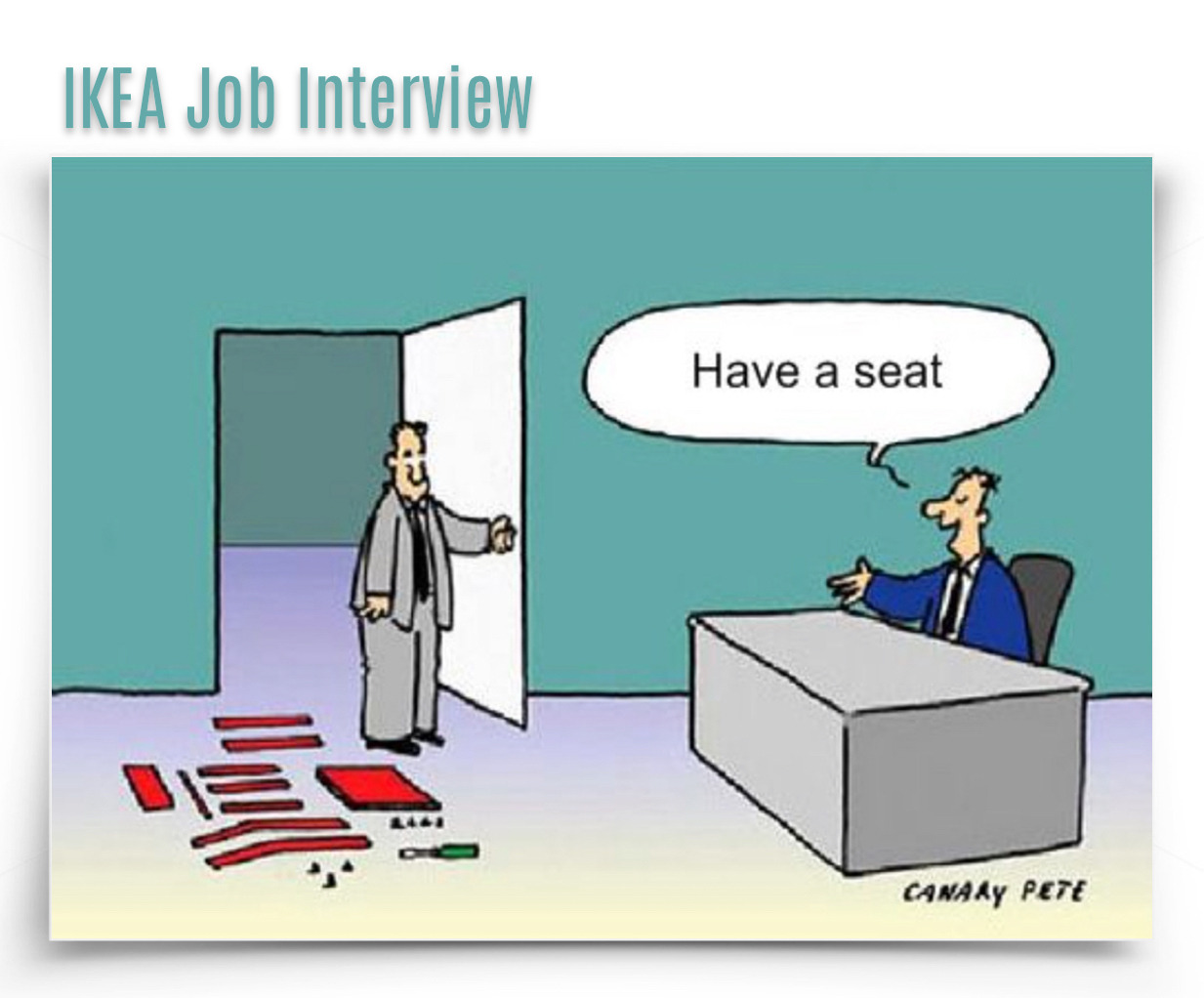
You may have come across the comic showing the interviewer saying “Take a seat” to a the man entering. In the place of the chair is a collection of chair parts. That’s because it’s identified as an interview for IKEA, the brand associated with furniture that comes in pieces to be put together by the customer.
Until now that’s rather the way it’s been for the online IKEA shopper, as well. They had to put the pieces together themselves. The problem was not that IKEA didn’t have an app; it’s that it had three separate ones that do not integrate and allow the customer to do everything on a mobile device.
The catalog app allows you to view hundreds of pages of merchandise on your phone, but not to place an order, which can only be done on the IKEA site. The virtual reality app called “Place” allows you to visualize its products in your home. While the tech, which was introduced in 2017, is both useful and cool, it doesn’t deliver with a buy option.
In the process of exploring the final frontier, the crew of Star Trek made use of technology born of the creator’s imagination. But much of that technology has been realized - at least to some extent - by the year 2019.
Communicators
Should you still have a flip-style phone in your possession, like I do, you have a piece of tech straight out of Star Trek. In fact, TrekMovie.com suggests "the modern flip-style mobile phone was inspired by the communicators from the original Star Trek.” As Oscar Wilde famously quipped, “Life imitates art.” This has proven true for our cell phones.
So back when Paramount was working on releasing its 2009 Star Trek movie, it partnered with Nokia and Verizon for a Star Trek-themed promotional campaign.
Europeans even had the opportunity to purchase a special Star Trek version of the Nokia 5800 (non-flip) cell phone, which threw in “some Star Trek-themed content.”
There must have been some really die-hard fans of the original series at Nokia. Back in 2008, they built 14 prototypes of a cell phone that looked exactly like the communicators used by Captain Kirk and his crew with the functionality of the Nokia N76 flip phone.
The universal translator
The fleet on Star Trek often has to communicate with aliens whose native language is not English, and once in a while, you do get to hear Klingon or another alien language. But most of the time, everyone is speaking in English. How does that work?
The Doctor Who series explains the same phenomenon by saying the Tardis automatically translates everything expressed by both humans and aliens; Star Trek attributes it to something much smaller known as the universal translator.
If you have any questions at all about how its function and evolution has changed throughout the different manifestations of the series, you can likely find it on the Memory Alphasite. It cites the original series’ creator, Gene Roddenberry who wrote the following:
“We establish a ‘telecommunicator’ device early in the series, little more complicated than a small transistor radio carried in a pocket. A simple ‘two-way scrambler;’ it appears to be converting all spoken language into English."
Takeaway:Women have long been a minority in tech, but what do those in the field most want from their employers and careers in general? We discussed this with women currently in tech, and here’s what they had to say.
To find out what women in tech want, we asked them. A query to HARO drew a large number of responses. Everyone wants equal opportunity, though some experience it more others. Some women share positive reports for the level of female representation at their places of work, while others still feel the sting of being overlooked by those who direct technical questions only to the men in the room. However, their thoughtful responses include not just what women want but what practical steps will get us there.
’ll Have What He’s Having
There’s no mystery, really. “Women in tech want exactly what men in tech want,“ asserts Amy Romero, global CMO at CreativeDrive. That means, “More opportunities for advancement, the ability to work on challenging projects that fuel their creative drive, unlock hidden potential and sources of growth, and role models in leadership positions.“
That sentiment is echoed by a number of women, including Ashley Fry: “Women in tech ultimately want a culture and environment to be cultivated that equals the playing field compared to their male counterparts.”
“Turning disabilities into superpowers” is the defining vision of UK-basedOpen Bionics. Their mission is to create “affordable, assistive devices that enhance the human body.”
Their first product was theHero Arm, which they describe as “the world's first medically certified 3D-printed bionic arm, with multi-grip functionality and empowering aesthetics.” It is “a lightweight and affordable myoelectric prosthesis.”
Dedication to helping children by providing them with 3D printed hands is also the driving passion behind a group of volunteers who formed e-NABLE. Its members now number in the thousands, and they have made it possible for thousands of children around the world to regain hand function. See the video below:
Quick and economical home construction
Another way 3D printing is being used to make the world a better place is by reducing the cost of home construction enough to make new houses accessible to those whose income puts adequate shelter beyond their reach.
One company that has made this its mission is ICON. Its tagline is “We’re changing the way people live.” It set out to apply 3D printing to houses and envisions whole communities set up that way in a kind of 21st-century version of Levitton.
Last year ICON built the Chicon house, described as “the first permitted 3D-printed home built in the United States” in Austin, Texas in 2018. It took a few weeks to print “and sparked the imagination of customers, investors, press, and the SXSW conference community.”
Now it has advanced the technology to the point where it can get a house up in just a day and at a cost of just $4000 as you can see in this video:
ICON believes that its 3D printing applied to concrete is the solution to low-income housing, both in the USA and abroad. To that end, it has partnered with a charity called New Story that has provided funding for homes in Mexico, Haiti, El Salvador, and Bolivia and for needy households.
“By partnering with ICON in select regions, New Story will be able to see out their vision more efficiently and deliver the promise of a life beyond survival to thousands more,” it reports.
4. Homes on Mars
Applying 3D printing to home construction also has ramifications for the space program. In planning a mission to Mars, NASA has to deal with the challenge of setting up shelter for the people who will be living on the red planet. To that end, it launched the 3D-Printed Habitat Challenge



 Posts
Posts

